Where New York Goes to Exhale
Contributed by travel writer Jens Hoffmann
Beyond the skyline, Long Island offers another version of New York—one of oysters and ocean air, vineyard rows and farm stands, caviar and country clubs.
We’ve been to New York City plenty of times. We know the skyline, the noise, the energy, the restaurants that never seem to close.

But this time, we wanted to know what happens when New York lets go.
So we headed east.
The change is almost imperceptible at first. The city gives way to suburbs, suburbs to fields, and eventually the landscape opens towards the water. On the South Fork, the famous Hamptons unfold in a procession of manicured villages, discreet driveways and oceanfront estates. Further north, the mood shifts again: vineyards, farm stands, seafood shacks and small-town America.
Long Island is many things at once.
And sometimes, rather wonderfully, it puts caviar on an omelette.
The caviar arrives first.
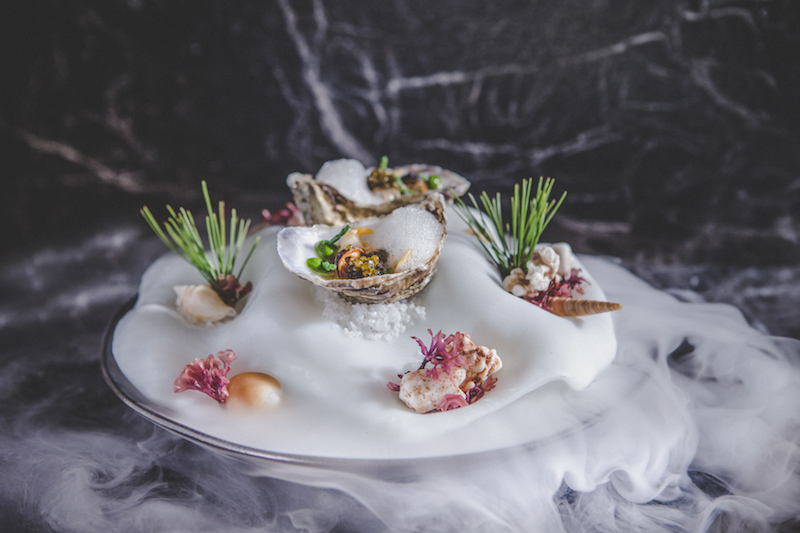
Tiny black pearls burst across the palate, intensely saline and almost buttery. Then comes the oyster—fresh from the bay, briny and cold, with that unmistakable taste of the Atlantic.
These are not just any oysters.
The oysters of Southold Bay are Crassostrea virginica, the Eastern oyster, cultivated in a section of the bay marked by buoys. Each oyster can filter up to 200 litres of water in 24 hours.
There is something almost poetic about that.
And something useful, too.
New York State has invested in restoring oyster populations after centuries in which oysters were once extraordinarily abundant in the waters around the city. They were so plentiful that ordinary New Yorkers could simply collect them themselves.
Fast food, nineteenth-century style.
Plenty of protein. Nothing to unwrap. Just reach into the water.
Today, oysters are no longer everywhere. But on Long Island, they remain an important part of both the local ecosystem and the table.
And increasingly, the two are understood to belong together.
Long Island’s South Fork is where the island’s mythology takes over.

The Hamptons have long been New York’s summer playground—a place where city money comes to breathe sea air. The landscape is familiar from photographs: shingled houses hidden behind hydrangeas, immaculate lawns, beach clubs, bicycles leaning outside cafés, and boutiques whose prices suggest that Fifth Avenue is never very far away.
Westhampton. Southampton. Bridgehampton. Sagaponack. East Hampton.
And finally, Montauk, at the very end of the road.
The further east you go, the more the Hamptons begin to loosen their grip. The polished glamour gradually gives way to surf culture, fishermen, wide beaches and a more relaxed kind of summer.
That range is part of the appeal. The Hamptons can be extravagantly expensive and wonderfully casual within the same afternoon. You might spend the morning on a pristine beach, lunch on oysters, and the evening at a vineyard—or at a country club where the dress code is taken more seriously than the conversation.
It is, in other words, very New York.
Just with more sand.
Then there is the North Fork.
It feels like a different island.
The glamour of the South Fork is replaced by farmland, roadside stalls and vineyards. Trucks sell peaches and tomatoes. Small signs point towards farm shops. The roads seem to slow down.
This is Long Island’s agricultural side—and its wine country.
The climate is surprisingly hospitable to vines. Long Island sits on roughly the same latitude as Rome and Madrid, while the surrounding Atlantic helps moderate the temperatures.
The result is a wine region that has quietly earned serious attention.
Paumanok Vineyards is now part of the local establishment, and its wines have even found their way to the White House.
Then there is Roman Roth.
At Wölffer Estate in Sagaponack, Roth has become one of Long Island’s best-known winemakers, producing elegant wines that have gained recognition well beyond New York State.
The vineyards cover around 71 hectares, planted in Long Island’s characteristic soils—sandy beneath, with layers of clay above.
Merlot. Chardonnay. Pinot Noir. Trebbiano. Vignole.
The names may be European. The sense of place is distinctly Long Island.
And despite the accolades, the atmosphere remains pleasantly unpretentious. At vineyard festivals, celebrities and locals mingle with glasses in hand. There is no velvet rope between the two.
Perhaps that is another Long Island paradox: luxury without necessarily having to announce itself.
The same philosophy can be found in the kitchen.
Jerry DiCecco travelled through France and Italy before bringing those influences home. In New York City, he worked for Daniel Boulud, one of the great French chefs of the American restaurant scene.
Today, DiCecco is back in Riverhead.
At Jerry and the Mermaid, fine dining meets the more democratic traditions of American eating. It is polished without being precious. A celebrity can sit beside a local. Everyone comes for the food.
And that matters here.
Because Long Island’s culinary identity is increasingly built around proximity.
The idea of eating local is fashionable almost everywhere. On Long Island, it can still be remarkably literal.
The vegetables might come from the farm down the road.
The wine from the vineyard you passed twenty minutes earlier.
And the seafood?
From the surrounding waters.
Cody Homan, general manager of Braun Seafood in Cutchogue, knows exactly where that seafood comes from.
His customers include some of the island’s most demanding chefs and private chefs—the kind who cook for households where dinner is an event in itself.
But they also include ordinary Long Islanders.
That is the beauty of the place.
You do not need to own a mansion in East Hampton to eat exceptionally well.
Sometimes all you need is a good fishmonger.
And a little ambition.
The most memorable dish may also be the simplest.
An omelette.
But this is Long Island, so the omelette comes with caviar.
Imagine crisp rösti, whipped crème fraîche, chives, poached eggs and warm brioche. Then add a generous spoonful of roe.
The effect is unexpectedly familiar. The delicate saltiness of the caviar almost suggests a cheese omelette—rich, savoury and deeply satisfying.
There are eight varieties of caviar to choose from, sourced from aquaculture farms in different parts of the world. Each has its own texture, saltiness and character.
It is less a meal than a small education in luxury.
Prices range from around $95 for 30 grams of White Sturgeon to $540 for 80 grams of Selection Oscietra.
Extravagant?
Absolutely.
But Long Island has never been afraid of a little extravagance.
What makes Long Island fascinating is not simply the wealth, the beaches or the food.
It is the contrast.
The island can be polished and rustic, glamorous and agricultural, old-money and thoroughly democratic. One moment you are looking at a vineyard; the next, an oyster bed. One evening you might be drinking an elegant local Chardonnay; the next morning, buying tomatoes from a roadside farm stand.
The Hamptons may be the version of Long Island that the world knows.
But the North Fork, the fishermen, the farmers, the winemakers and the oyster growers reveal something more intimate.
This is where New York comes to slow down.
And perhaps that is the real luxury.
Not the caviar.
Not the mansion.
Not even the vineyard.
It is the possibility of leaving the city behind without really leaving New York at all.
Getting there: From Germany, direct flights are available to New York’s John F. Kennedy International Airport and Newark Liberty International Airport. From New York City, Long Island is accessible by car or by the Long Island Rail Road.
Getting around: A car is the easiest way to explore the East End, particularly if you want to combine the Hamptons, the North Fork