An exploration of northern Vietnam, where extraordinary landscapes meet an ancient mythology and a mythical creature continues to shape the soul of a nation.
Contributed by Jens Hofmann
There are places on this earth whose beauty seems almost impossible to capture in words. Northern Vietnam is home to some of them: a maritime wonderland of thousands of fantastically sculpted limestone islands, rice terraces cascading down mountain slopes like enormous works of green art, and a culture in which one mythical creature appears to watch over everything: the dragon.

It is the ruler of the heavens, a bringer of good fortune and a symbol of a nation’s identity stretching back through centuries.
The Vietnamese know, of course, that dragons are creatures of legend.
And yet they are everywhere. On temple roofs, building facades, in paintings, festivals and stories passed down through generations. The dragon is far more than a decorative motif. It represents happiness, wisdom, strength and power.
Our destination is northern Vietnam. Hanoi and the legendary Ha Long Bay. Two places that could hardly be more different, yet are connected by a shared cultural heritage.
A Capital Under the Sign of the Dragon
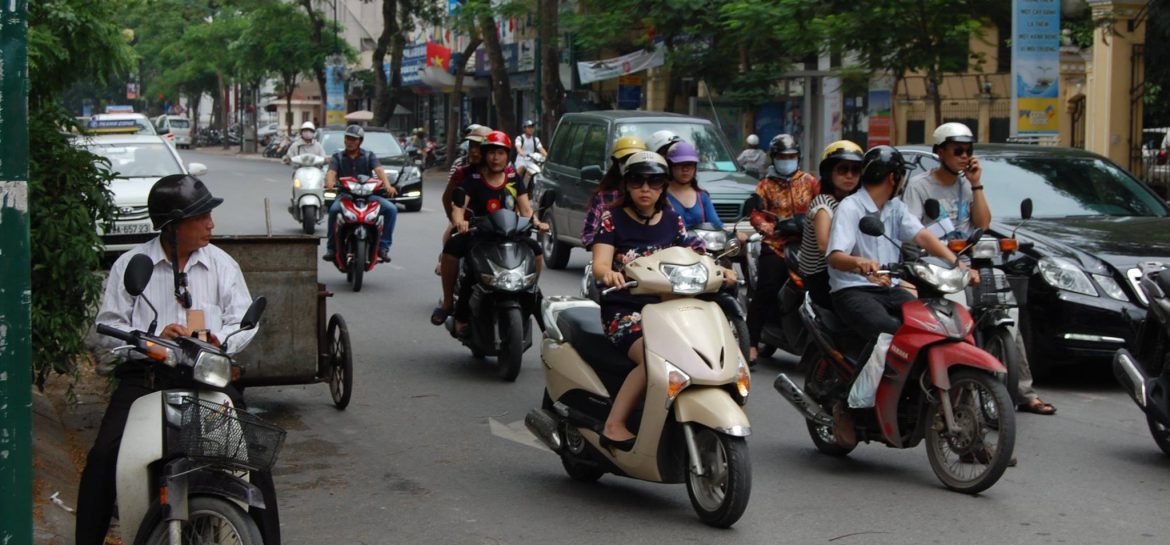
Hanoi is a city where history and modern life intertwine in endlessly fascinating ways. Amid ancient temples, colonial architecture, bustling streets and the ceaseless flow of motorbikes, the past never seems entirely out of reach.
Above it all hovers the symbol of the dragon.
In Vietnamese culture, the twelve animals of the zodiac hold particular significance. Each represents a year and is associated with certain characteristics. The Year of the Dragon is traditionally regarded as especially auspicious.

Uncle Ho, Ho Chi Minh, seems to watch over the country as well. His familiar smiling portrait appears time and again, a quiet companion on a journey through a nation that carries its history with remarkable ease into everyday life.
The dragon, however, reaches much further back into the past.
Once, it was the exclusive emblem of royal authority. Objects belonging to the emperor, ceremonial robes and the architecture of royal palaces were frequently adorned with dragon motifs. Ordinary people were not permitted to use the symbol. The dragon belonged to the king.
Its significance, however, is rooted in more than the history of dynasties. One of Vietnam’s best-known legends tells how the Vietnamese people descended from the union of a dragon and a fairy. Mythology and national origins merge into a story that remains deeply embedded in the country’s cultural identity.
Thang Long – The City of the Ascending Dragon
Around a thousand years ago, the dragon assumed an extraordinary role in the history of Vietnam’s capital.
At the beginning of the Ly Dynasty, King Ly Thai To ruled the country. The capital was then located in Hoa Lu. According to legend, the king had a dream: he saw a dragon rising from the water and ascending into the sky.
The place where this vision supposedly occurred became the site of a new capital.
The king moved his seat of government there and gave the city a name that still resonates today: Thang Long – the Ascending Dragon.
Only centuries later would the city acquire its present name, Hanoi.
Under subsequent dynasties, the dragon became a defining feature of royal architecture. Palaces, temples and important buildings were adorned with its image. It became an emblem of a monarchy whose authority was closely associated with the heavens.
Against this historical backdrop, it is hardly surprising that Hanoi continues to pay such special attention to the dragon.
Vietnamese filmmakers return to the subject time and again. Artists incorporate it into their work, and even the geographical outline of the country is sometimes interpreted in its shape.
A Dragon Called Vietnam
On a map, Vietnam appears as an elongated S, stretching for more than a thousand kilometres along the South China Sea.
But the Vietnamese have another way of imagining the country’s silhouette: they see a dragon.
Its head lies in the north, its body winds along the coastline, and its tail reaches as far as Ca Mau, at the southernmost tip of the country.
There, in the sprawling Mekong Delta, the great river divides into numerous waterways.
The number nine carries particular symbolic significance. The Vietnamese name for the Mekong is Cửu Long – Nine Dragons.
The river’s many branches are associated with these nine dragons. A geographical feature thus becomes an expression of cultural identity. The dragon does not merely fly above Vietnam. In a sense, it has become the country’s very embodiment.
When Dragons Dance Through the Streets
The dragon’s presence is by no means confined to temples and ancient legends. It is also part of everyday Vietnamese life.
There are dragon dances, dragon boat races and traditional children’s games in which the mythical creature plays a role. One of them is called Rồng rắn lên mây, which can be loosely translated as The Dragon Snake Ascends to the Clouds.
Several children line up behind one another, holding on to the shoulders or waist of the child in front. Together, they form a long, winding chain. As the group tries to maintain its formation, the opposing team attempts to catch individual children.
It is a simple game, yet one that connects generations and preserves a glimpse of the mythical world in which dragons roam through clouds and skies.
In Vietnam, the dragon is regarded as the wisest and noblest of mythical creatures. It is associated with a pure heart, wisdom and a benevolent spirit.
Some couples even plan their family life around the zodia and hoping to give their children the best start by choosing the perfect year of birth and marriage.
The celestial dragon is an entirely benevolent figure. It embodies goodness, strength and harmony. Its power is not threatening but protective.
The Smile of a Nation
Perhaps this is what makes Vietnam so captivating: its ability to weave myth and reality together. An ancient legend becomes a national symbol, a mythical creature becomes part of everyday life, and the history of a city turns into a story about the rise of a dragon.
As we make our way through Hanoi, these images stay with me. The temple roofs, the ancient stories and the mysterious landscapes of the north, where emerald waters disappear between towering limestone cliffs.
Soon we will see Ha Long Bay, that spectacular seascape whose islands rise from the water like the stone backs of sleeping dragons.
Perhaps it is precisely this blend of nature, history and mythology that makes Vietnam so irresistible.
The dragon is a creature of legend. We know that now.
But sometimes, one does not need real dragons to believe in the extraordinary.
I love Vietnam.