From the series: “Traveling in Europe”
Tips for Connoisseurs
By feature reporter Jens Hoffmann
Discover these amazing lakes by bicycle, train, and boat.

Why not.
I’ll say it right up front: the cross-border journey between these various lakes was truly enjoyable.
Every time I hopped from the jetty onto the boat, a new captain and a sparkling lake awaited me.
Lake Maggiore, Lake Orta, Lake Lugano, and Lake Como are lakes that captivate not merely through their beauty, but through a distinctive aura that defies immediate description.
They possess a stylish, majestic presence that radiates positive energy and brings a sense of happiness.

They are neither spectacular natural wonders nor dramatic backdrops; they are simply graceful and beautiful.
As a travel journalist, I have seen a great lakes, but for me, these lakes rank among those rare places you must see.
Wow!
Everyone can find a reason—or a secret desire—to choose this destination.

We aren’t talking about a “bucket list” item here, but rather an exquisite blend of water, mountains, and vegetation.
After arriving at Milan-Malpensa Airport, we began our journey at Lake Maggiore and Lake Orta.
There, one finds a charming island and the delightful village of Orta San Giulio. We took a narrow-gauge railway into the Vigezzo Valley, which extends all the way to Ticino.
After a stop in Locarno—a well-known Italian-speaking resort town in Switzerland—we continued to Lugano and finally took to the water. A boat trip across Lake Lugano brought us to Porlezza and Oria.
Villa Fogazzoro Roi is located here; compared to the magnificent splendor of many other villas, it has a more understated character. Situated directly on Lake Lugano with a terraced garden, the villa inspired the writer Fogazzaro to pen his world-renowned novel *Piccolo mondo antico*.
We slept well here; the journey is the destination—off to Lake Como.
At Lake Como, you can set out to find the film locations of movies such as *The Devil Wears Prada*, *Star Wars*, or *James Bond: Casino Royale*.
You can cycle stages of the *Giro d’Italia*, play on beautiful golf courses or just drink Dom Perignon (Magnum).

Water sports enthusiasts, sailors, pedal-boaters, excursionists, beach lovers, and those who simply enjoy the good life all love these lakes.
Here, the landscape has become both a source of inspiration and a stage.
The Northern Italian lake district is wonderful for limitless trekking and hiking, yet it is also suitable for older people and children.
Thoughts easily drift back to the *Belle Époque* era; truly, everyone finds something to love here.
Opera lovers at Lake Como will quickly find themselves thinking of Bellini; he was a regular visitor here and composed the opera *Norma* in this setting.
The famous aria “Casta Diva” captures the mystical atmosphere of the lake.
Verdi, too, was likely inspired by this mood.
*La Traviata* was created here.
We are both opera fans.

Alessandro Manzoni and Goethe—and in modern times, Clara Bernardi and Oliver Maria Schmitt—have drawn upon this atmosphere to write their books.
Pop stars, industrialists, writers, and actors like George Clooney still regularly visit Northern Italy and are fond of Lake Como.
European culture thrives around all these lakes.
Between the steep mountain slopes and the deep blue of the lakes, a connection forms between seclusion and vastness—something that brings order to our thoughts and shifts our perspectives.
While the water lies almost motionless in the sunlight, a horizon opens up above the mountain peaks, broadening our view of the world.

Long ago, many famous figures discovered this region as a place for distinguished seclusion.
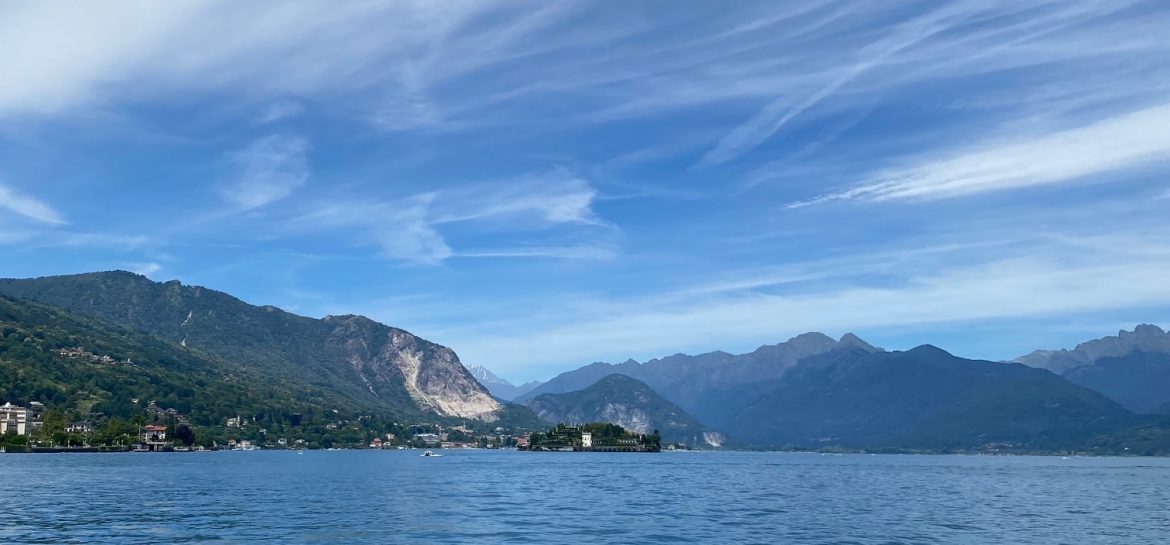
Winston Churchill always loved returning to Lake Como. Napoleon Bonaparte and his wife Josephine stayed at the Palazzo Borromeo on Isola Bella, as did Caroline, Queen of England.
She fell so deeply in love with the island that she wanted to buy it.
The purchase did not go through; instead, the terraced gardens were laid out.
Perhaps the lakes’ allure lies in their very geography.
Lake Como, in the heart of the Prealps, cuts 410 meters deep into the rock, with Lake Maggiore (372 meters) following close behind.
The lakes were formed by the massive glacial movements of the last Ice Age and possess that elongated shape that draws the gaze toward the horizon.
Steep mountain slopes direct light onto the water’s surface like reflectors; in the morning, mist rises slowly from the valleys, while at midday the facades of lakeside towns shimmer, and towards evening, the mountains transform into an ethereal blue.
Every hour alters the landscape’s character without changing its essential expression.
It is worth to visit.